Sequence stratigraphy uses regionally
correlative surfaces to subdivide a succession of strata; in nonmarine strata,
marine flooding units can provide important tie points. In this study, Ielpi documents several
marine bands in late Miocene lacustrine-paralic deposits of the Northern
Apennines and illustrates their use in basin and sedimentologic analysis. The data reveal that low-frequency sequences bounded
by major marine incursions are regionally correlative and respond to regional
high-amplitude base level fluctuations; in contrast, nested high-frequency
sequences are noncorrelative and respond to local low-amplitude base level
fluctuations. The results are interpreted to underscore the role of
differential subsidence in the generation of asymmetrical sequence
architectures and the alternation between hydrologically balanced and
underfilled phases in high-accommodation and low-topography settings.
Friday, May 31, 2013
Thursday, May 30, 2013
Highlights—Impact of the Impact
The nature of the Cretaceous-Paleogene
boundary, and the events recorded in that interval, remain the subject of
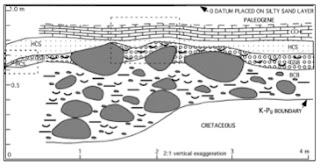
considerable debate. Here, Yancey and Liu describe sedimentologic and stratigraphic data from twenty
sections along the Brazos River and from nearby cores. The data include a dominance of mass
flows and tempestites that include impact ejecta, and are interpreted to
represent the record of mass flows and numerous great storm events associated
with the Chicxulub impact, followed by a return to normal conditions. The data suggest that tsunami waves are
not a pronounced influence, contrary to previous interpretations.
Impact-Induced
Sediment Deposition On An Offshore, Mud-Substrate Continental Shelf, Cretaceous–Paleogene
Boundary, Brazos River, Texas, U.S.A.
by Thomas E. Yancey and Chengjie Liu
Thursday, May 23, 2013
Highlights—Limestone Clasts, Back in Black
Subaerial exposure surfaces in
carbonate successions throughout the geologic record include blackened clasts,
but the origin of these clasts has remained the subject of debate. In this contribution, Miller et al. describe the distribution, microstructure, and diagenesis of
blackened clasts in the Neogene succession of Australia. The results illustrate that the clasts
are colored by organic carbon, interpreted to be formed in shallow the subsoil
(B-C soil horizon) by a complex mix of dissolution and trapping of soil-derived
organic matter by rhizogenic calcification. The results illustrate the complex genesis of these features
and the climatic conditions under which they form.
Genesis of Blackened Limestone Clasts At Late Cenozoic Subaerial Exposure Surfaces, Southern Australia by Cody R.
Miller, Noel P. James, and T. Kurtis Kyser
Friday, May 17, 2013
Highlights—Changing Depositional Regimes and Sandstone Variability
Marginal marine depositional systems
vary markedly across strike, but along-strike variability is less commonly explored. Painter et al. describe study of a
14-km long outcrop window of the Cretaceous Sego Sandstone Member (Mesaverde
Group, Upper Cretaceous), and compare the sedimentology and stratigraphy with
the well-studied Book Cliffs region.
The results illustrate three sequences of roughly similar thickness to
the Book Cliffs, but that this area included more tidal and fluvio-deltaic
systems. The spatial and temporal
changes in depositional systems are interpreted to reflect changes in
paleogeography, and the authors suggests that comparable changes in subsurface
analogs would lead to changes in reservoir quality, continuity, and geometry.
Sequence Stratigraphy of the Upper Cretaceous Sego Sandstone Member Reveals Spatio-Temporal Changes In Depositional Processes, Northwest Colorado, U.S.A. by Clayton S. Painter, Carly C. York-Sowecke, and
Barbara Carrapa
Thursday, May 16, 2013
Highlights: 2013 Honorary Member: Dale Leckie
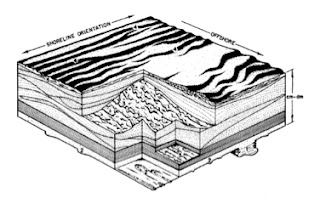
In shelf regions, geostrophic currents, or flows in
which the pressure gradient force is balanced by Coriolis forces, result in
water motion at a low angle to the shoreline. These currents have been interpreted to represent important
mechanisms for cross-shelf transport.
In this paper, SEPM Honorary Member Dale Leckie and Krystinik (1989) summarized paleocurrent information
from a number of ancient progradational shoreface successions to test the
interpretation of the importance of these deposits. Systematic analysis of 8 formations from North America and
Europe revealed a predominance of currents oriented offshore at angles between
70-90 degrees, a result
interpreted to reflect a lack of record of geostrophic currents on the
sedimentary record preserved in these successions. So…the answer to the question in their title was interpreted
to be… “no.”
Is there evidence for geostrophic currents preserved in the sedimentary record of inner to middle-shelf deposits? by Dale A.
Leckie and Lee F. Krystinik, Journal of Sedimentary Research, v. 59, p. 862-870.
Wednesday, May 15, 2013
Highlights: 2013 James Lee Wilson Award: Kyle M. Straub
Many sedimentary systems include channelized bodies. These channels can be distributed randomly or can preferentially fill topographic lows at the time of deposition (termed compensational stacking). Exploring the stacking patterns of meter- to km- thick channelized packages from river delta to deep-water minibasins in six separate basins, award winner Kyle Straub and others (2009) described a suite of measurements that suggest that stacking patterns of channelized deposits are midway between the random and the compensational end-members. They interpreted the results to reflect that channel depth is a fundamental length scale that controls stratigraphic architecture across a range of depositional environments, and hence can be used to better constrain geologic models.
Compensational stacking of channelized sedimentary deposits, by K.M. Straub, C. Paola, D. Mohrig, M.A. Wolinsky, and T. George, Journal of Sedimentary Research, v. 79, p. 673-688, DOI: 10.2110/jsr.2009.070.
Tuesday, May 14, 2013
Highlights: 2013 Pettijohn Medalist: J.A.D. (Tony) Dickson
Secular changes in seawater chemistry, including the
Mg/Ca ratio, control the preferred abiotic carbonate precipitate from aragonite
to calcite and back. In this
paper, Pettijohn Medalist winner Tony Dickson (2004) empirically tested hypotheses regarding these controls using the composition
of Mg-calcite rich echinoderms through the Phanerozoic. The data revealed low Mg/Ca ratios in
the Jurassic and Cretaceous, and highs during the Cambrian, late Carboniferous
to Triassic, and today; trends broadly follow proposed first-order Mg/Ca raios
from geochemical models and fluid inclusions. These results were interpreted to represent independent
confirmation of the general first-order trends derived from other means.
Echinoderm skeletal preservation: Calcite-aragonite seas and the Mg/Ca ratio of Phanerozoic oceans by J.A.D. (Tony) Dickson. Journal of Sedimentary
Research, v. 74, p. 355-365.
Monday, May 13, 2013
Highlights: 2013 Twenhofel Medalist, Paul Enos
Primary depositional intergranular pore systems
markedly impact porosity and permeability, influence diagenetic processes and
control recovery of resources in many reservoir and aquifer systems. In this pioneering study, Twenhofel
Medalist Paul Enos and Sawatsky (1981) explored the depositional
aspects of porosity and permeability by documenting their change in different
Holocene carbonate sediment textures.
The results indicated that carbonate mud-rich sediment (fine wackestone)
includes the highest porosity (with up to 70%); mud-free grainstone includes
40-50% porosity. The results
provided information on the baseline initial conditions of sediment porosity,
for comparison with changes in porosity with compaction and diagenesis.
Pore networks in Holocene carbonate sediments by Paul Enos and L.H. Sawatsky
Journal of Sedimentary Petrology, v. 51, p. 961-985.
Friday, May 10, 2013
Highlights—Tufas and Paleoclimate
As rapidly precipitating freshwater
carbonate accumulations that form in equilibrium with ambient water, tufas
represent potential sources of high-resolution paleoenvironmental records. To critically examine the use of tufa
isotopic records in such reconstructions,
Osácar et al. examine a 12-year record of a modern tufa system,
comparing water δ18O with δ13C and δ18O signatures in the precipitates. The data illustrate that these tufas
mimic seasonal temperature changes, but that the pattern is complicated by
changes in the isotope record of precipitation. These results are interpreted to illuminate the complex interaction
of factors operative at several different type scales (seasonal and annual)
that must be evaluated to accurately understand the isotopic record of ancient
tufa systems.
Environmental Factors Controlling the δ13C and δ18O Variations of Recent Fluvial Tufas: A 12-Year Record from the Monasterio de Piedra Natural Park (NE Iberian Peninsula) by M. Cinta Osácar,
Concha Arenas, Marta Vázquez-Urbez, Carlos Sancho, Luis F. Auqué, and Gonzalo
Pardo
Wednesday, May 8, 2013
Highlights—Hydrographs and Hyperpycnites
Hyperpycnites are deposits of a distinct style of flow
that represents a mix of sediment and water that is denser than the water into
which the mix flows; these types of deposits commonly are interpreted in the
context of fluvial discharge into standing bodies of water. Here, Saitoh and Masuda test
conceptual and experimental models of hyperpycnal flow deposits by exploring
spatial variability in subaqueous flood deposits in cores from a lake in Japan
with limited wave or tide reworking.
The results clearly indicate that a single flood event can produce multiple
eposides of waxing and waning flow, and the nature and controls on spatial
variability in the sedimentology of the resultant deposits.
The results suggest the absence of
a direct correlation between paleo-flood frequency or intensity and the
sedimentary record.
Spatial Change of Grading Pattern of Subaqueous Flood Deposits in Lake Shinji, Japan by Yu Saitoh and Fujio Masuda
Tuesday, May 7, 2013
Highlights—SEPM Medalists
Each year, SEPM honors a group of medalists for their
outstanding contributions to sedimentary geology. This week, we start a series to honor some of the recipients
by providing “Highlights” of their contributions to JSR.
The 2013 awardees include:
Twenhofel Medalist: Paul Enos. The
highest award of SEPM Society for Sedimentary Geology. This award is in
recognition of "Outstanding Contributions to Sedimentary Geology."
Shepard Medalist: J. Casey Moore. The
Francis P. Shepard Medal for Marine Geology is awarded in recognition of
"Excellence in Marine Geology."
Pettijohn Medalist: J.A.D. (Tony) Dickson. The Francis J. Pettijohn Medal for Sedimentology is
awarded in recognition of "Excellence in Sedimentology."
Moore Medalist: Kenton Stewart Wall Campbell. The Raymond
C. Moore Paleontology Medal is awarded in recognition of "Excellence in
Paleontology."
James Lee Wilson Award: Kyle M. Straub. The James Lee Wilson
Award is bestowed in recognition of "Excellence in Sedimentary Geology by
a Young Scientist."
Honorary Member: Dale
Leckie. Honorary
Membership in the SEPM Society for Sedimentary Geology acknowledges excellence
in professional achievements and extraordinary service to the Society.
Monday, May 6, 2013
Highlights—Paleosols and Paleoclimate
To evaluate climatic conditions through
the geologic past, the stable isotopes of carbon and oxygen in paleosols have
been evaluated to assess ancient atmospheric CO2 concentrations and
paleo-atmospheric circulation patterns.
Yet, these records may be compromised if they do not precipitate in
equilibrium with soil CO2 and soil water. Michel et al. assess this possibility by examining the isotopic
record of modern Vertisols (a soil class) that include a range of material
incorporated from underlying marine limestone, a potential contaminant. The results indicate the roles that
soil development, weathering, and topographic position can play in compromising
the soil signal. They suggest that
inheritance (contamination) from precursor substrates can alter a “climate”
signal in some cases, and should be assessed in application of geological soils
for paleoclimate studies.
Stable-Isotope Geochemistry of Vertisols Formed On Marine Limestone and Implications for Deep-Time Paleoenvironmental Reconstructions by Lauren A. Michel, Steven G. Driese, Lee C. Nordt, Daniel O.
Breecker, Dana M. Labotka, and Stephen I. Dworkin
Friday, May 3, 2013
Highlights—Brrrr…The Cold Facts about Cryogenic Cave Pearls
Cave pearls are a distinct
form of loose, spherical mineral deposit precipitated in caves (speleothems). This paper by Žák et al. describes a genetically
distinct type of cave pearls found in seasonally frozen ice caves of Carpathian
Mountains, termed “cryogenic cave pearls.” Integrating petrographic, SEM, U-series and radiocarbon
dating, and stable carbon and oxygen isotope analyses, they illustrate the
essential role of seasonal freezing and frost action in the formation of
cryogenic cave pearls. The results
provide unique insights into the genesis of these features, and into conditions
necessary for cave pearls in general.
Cryogenic Cave Pearls In the Periglacial Zones of Ice Caves
by Karel Žák,
Monika Orvošová, Michal Filippi, Lukáš Vlček, Bogdan P. Onac, Aurel Perşoiu,
Jan Rohovec, and Ivo Světlík
Monday, April 29, 2013
Highlights—Microbes Pumping Iron(stone)
Oolitic ironstones occur quite frequently in condensed sections in the stratigraphic record and can serve as important iron resources. In this paper, Barale et al. use a Cretaceous condensed section to explore the conditions in which mixed Fe-oxide / Ca-phosphate ooids form, why they usually show an ellipsoidal shape in spite of a sub-equidimensional nucleus, and why Fe-oxide cortical layers intimately alternate with Ca-phosphate layers. Their results, which integrate cathodoluminescence, EDS microprobe, backscattered electron imaging, epifluorescence, XRD, and micro Raman spectroscopy, reveal a complex history of prolonged alterations of oxic and post-oxic conditions, interpreted to be related to alternating accumulation and winnowing, and related stop-and-start microbial activity. Collectively, the results provide new insights into the sedimentological and paleoenvironmental conditions in which oolitic ironstones form, detailing the sedimentation, shallow burial, reworking and sea-floor exposure of sediment that ultimately is composed almost exclusively of authigenic grains.
The Role of Microbial Activity In the Generation of Lower Cretaceous Mixed Fe-Oxide–Phosphate Ooids from the Provençal Domain, French Maritime Alps by Luca Barale, Anna D'atri, and Luca Martire
Friday, April 26, 2013
Highlights—Small Carbonate Platform Evolution—No Bull!
Small reefal platforms that
form in response to both tectonic and sea level changes are features ubiquitous
through the Phanerozoic. Commonly,
however, these small platforms are buried and limited data are available on
spatial and temporal lithofacies heterogeneity. This paper by McNeill et al. documents the
formation and timing of a ~90 km2 Pliocene-Pleistocene platform as
it evolved in a tropical, convergent tectonic setting (backarc) from a
siliciclastic foundation to a mixed system dominated by reefal carbonates. The results reveal three depositional
sequences defined using field relations and refined depositional ages using
strontium-isotope stratigraphy, magnetostratigraphy, and coral stratigraphy.
The spatial sedimentological patterns of the three sequences provide a
near-modern analog that illustrates lithofacies variability that may be present
in buried reefal platforms.
Depositional Sequences and Stratigraphy of the Colón Carbonate Platform: Bocas Del Toro Archipelago, Panama by Donald F. McNeill,
James S. Klaus, Laura G. O'Connell, Anthony G. Coates, and William A. Morgan
Thursday, April 25, 2013
Highlights—Marine Mudstone: Neither Homogeneous nor Isotropic
Mudstone-dominated marine successions are common in the geological record, but a full understanding of their depositional processes commonly is hampered by a lack of generally accepted diagnostic criteria to distinguish between hemipelagic settling and deposition from a flowing medium. In this paper, Dall’olio et al. integrate sedimentologic observations with analyses of the anisotropy of magnetic susceptibility (AMS) in the Miocene Marnoso Arenacea Formation of Italy to explore the utility of this technique for evaluating depositional processes. The results reveal that maximum susceptibility axes clustered within the depositional plane along the average palaeoflow direction inferred from flute casts at the base of the nearest turbidite beds. This fabric is interpreted as largely sedimentary in origin, due to the alignment within the bedding plane of paramagnetic/ferromagnetic grains; this result contrasts with the hemipelagic settling interpretation that is commonly invoked for this unit. Collectively, the results illustrate the value of AMS analysis in study of depositional processes.
Magnetic-Fabric Analysis as a Tool to Constrain Mechanisms of Deep-Water Mudstone Deposition In the Marnoso Arenacea Formation (Miocene, Italy) by Eleonora Dall'olio, Fabrizio Felletti, and Giovanni Muttoni
Tuesday, April 23, 2013
Highlights—Random Rivers Stack in Stratigraphy
The two end-member models of the facies architecture of alluvial-coastal
plain systems suggest that patterns are either predictable within
unconformity-bounded sequences or that they are substantively overprinted by
autogenic processes. In this
paper, Hampson et al. critically
appraise these end-member models of fluvial stratigraphy using detailed
architectural analysis of sandbodies developed at different positions within a
regressive alluvial-to-coastal plain wedge in the Upper Cretaceous Blackhawk
Formation of Utah. The results illustrate variations in the size and internal
organization of fluvial sandbodies, and the relationship between these
parameters and stratigraphic context; trends are broadly interpreted to reflect
decreasing tectonic subsidence through time, with random distribution of
sandbodies that represent large-scale avulsion (e.g., autogenic) processes. These results can be applied to
enhanced characterization of hydrocarbon reservoirs deposited in fluvial
environments.
Modest Change In Fluvial Style With Varying Accommodation In Regressive Alluvial-To-Coastal-Plain Wedge: Upper Cretaceous Blackhawk Formation, Wasatch Plateau, Central Utah, U.S.A. by Gary J. Hampson, Thomas O. Jewell, Nawazish Irfan, M. Royhan
Gani, and Bryan Bracken
Subscribe to:
Posts (Atom)