Although recently some have lamented the “demise” of carbonate
geology, practictioners in the field are not ones to let it die. Instead of
re-hashing what he considers to be more mundane aspects of carbonate
depositional systems, or argumentative aspects of cyclostratigraphy, Bruce Wilkinson starts from the
premise that “so much of carbonate sedimentology is crap” to develop the
concepts and applications of the future of carbonate geology—peloids and
pelotherapy. The Medical Subject Headings (MeSH) database of
the MEDLINE/PubMed defines pelotherapy as “The therapeutic use
of mud in packs or baths taking advantage of the absorptive qualities of the
mud. It has been used for rheumatism and skin problems.” Building on efforts of clay mineralogists, Wilkinson
argues that pelotherapy can take three approaches: 1) Geophagy, which utilizes the healing power of
the calcium carbonate-organic mix, but which can become addictive; 2) Psammotherapy (sand baths) useful for muscular-skeletal
diseases; and 3) Cosmetics, providing for a strong skrabiruyuschy effect. The
manuscript notes a niche (but growing) peloid travel destination,
clear relevance for modeling, and a strong and growing market –
after all, who doesn’t love a good peloidal mud bath?
Saturday, April 1, 2017
Monday, March 27, 2017
Highlights: Differences between the EARSs
The East African Rift System (EARS) includes a northern segment
that is more volcanically influenced than regions to the south. To explore the
roles of climate, tectonism, and volcanism and the architecture of sedimentary
deposits in rift basins, this manuscript by Mtelela and others provides a
sedimentologic investigation of the Pleistocene–Holocene upper Lake Beds, the
uppermost stratigraphic unit exposed throughout the Rukwa Rift Basin in
southwestern Tanzania. Integrating geologic mapping, lithofacies analysis,
petrographic microscopy, scanning electron microscopy, and radiocarbon dating
reveal alternating stacking patterns of landward- and basinward-stepping
alluvial to fluvial channel, deltaic, and profundal lacustrine strata, bounded
by unconformities. Sequence development in this rift basin is interpreted to be
controlled largely by base-level changes drive by interplay between climate
change and sediment supply, but was influenced by episodic volcanism in the
Rungwe Volcanic Province. Understanding these types of linkages is central
to efforts in evaluating the resource potential of rift basins; in this basin,
it also provides a foundational context for interpretation of regional
paleoclimate and paleoenvironmental setting of vertebrate fossils.
Interplay of structural, climatic, and volcanic controls on late Quaternary lacustrine–deltaic sedimentation patterns in the western branch of the East African Rift System, Rukwa Rift Basin, Tanzania by Cassy Mtelela, Eric M. Roberts, Robert Downie, and
Marc S. Hendrix
Wednesday, March 22, 2017
Highlights: The Skinny on Limestone Micropores
Although most agree that
micropores are important for scientific and economic reasons, geologists and
material scientists have diverse opinions on the very definition of microporosity
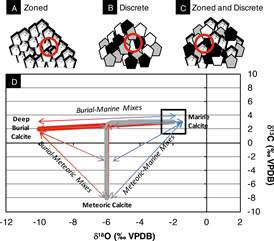
and its possible origin(s). To explore the nature and genesis of micropores, Hasiuk and others examine
bulk stable-isotope and elemental analyses from a range of microporous
limestone hydrocarbon reservoirs and a compilation of geochemical data from
previous studies of subsurface microporous limestones from the
Phanerozoic. Results illustrate microcrystals are composed of low-Mg
calcite, and geochemical data suggest most are abiotic origin, but modified by
shallow-burial diagenesis. On this basis, the authors suggest a uniform,
diagenetic origin during early burial for the micrite that hosts most
microporosity in limestone oil reservoirs. This understanding is a first step
in modeling the distribution of microporosity in reservoirs, enhancing accurate
prediction of reservoir performance.
Diagenetic origins of the calcite microcrystals
that host microporosity in limestone reservoirs by
Franek J. Hasiuk, Stephen E. Kaczmarek, and Shawn M. Fullmer
Monday, March 20, 2017
AE Interview: Get to Know Bruce Wilkinson
Q: What’s your
research?
A: Before its
demise, I used to profess expertise in the general field of carbonate geology;
often focused on making light of folk who worshiped at the church of our mother
of divine parasequence. More recent efforts are directed toward subjects that
are a bit more quantitative in flavor; my last paper was on trying to
understand the “Sadler Effect” when pretending that rainfall is meteoric
sediment. Today I finished up my input on using multidimensional scaling to
understand differences among ages of zircons in terrigenous samples, and am
working on a paper trying to derive intra-annual growth rates of clams from
stable isotope profiles.
Q: Where is
your favorite field area (and why)?
A: There are a
bunch (yes, I go to the field; at least I used to). I guess if I had to choose,
it would be the Miocene-Pliocene lake deposits along the southwestern margin of
the Snake River plain. Thick and
extensive lake-margin oolite and algal bioherms; hard to beat.
Q: What do you
enjoy about serving as JSR AE?
A: The demise
of carbonate geology (it’s the reason Rankey has time to write a JSR blog);
that “death” means much less work (I am damn near unemployed as a “carbonate
AE” for the Journal.
Q: What was
your favorite JSR paper from “back in the day” (or a recent year)?
A: I guess it
would be Bob Folk’s “The natural historyof crystalline calcium carbonate; effect of magnesium content and salinity”;
the man rather invented the field of carbonate geology.
Q: What are
your hobbies?
A: We live on
this 50-acre hobby farm in upstate New York; horses, goats, cats, turkeys,
guinea fowl, pea fowl, chickens, ducks, geese, pigeons; love my John Deere
tractor.
Q: What’s on
your favorite Pandora station?
A: I spend a
few bucks on Spotify; I clamp on those Sony noise-canceling headphones, and try
and do science to the likes of Tompall and the Glaser brothers, Justin Townes
Earl, the Gourds, and Mason Porter.
Thursday, March 16, 2017
Highlights: Connections and Transfers in Canyons
The
heads of submarine canyons represent a critical link in the transfer of
sediment from terrestrial sediment sources to deep basin sinks. Data from
modern canyons and submarine fans suggests the strength of this connection
determines the proportion and caliber of sediment stored in shelfal
environments relative to that which is transferred to deep-water. Sweet and Blum document
data on grain size, bathymetry and geochronology from twenty-four modern
submarine canyons that demonstrate this link to be very sensitive to the
distance between the canyon head and the shoreline, and, to a lesser extent,
wave energy. A surprising observation from these data is the close relationship
between the transport of grains of sand-size and coarser clasts and the distance
between the river mouth or shoreline and the head of the submarine
canyon. These data show the width of this zone filters the caliber of
sediment delivered into deep-water with important implications for
understanding sediment budgets and reservoir and seal distribution.
Connections between fluvial to shallow marine environments and submarine canyons: implications for sediment transfer to deep water by Michael L. Sweet and Michael D. Blum
Monday, March 13, 2017
Highlights: Caldera Sediment
Although
sedimentary deposits record the history of Earth-surface processes, only infrequently
they are used to understand volcanic systems. In this paper, Murphy and others study
the lacustrine sedimentary rocks deposited within the Long Valley Caldera,
California, to understand the evolution of the caldera. The results reveal the
nature of the volcaniclastic, chemical, and biogenic sediment, from near the
caldera margin (Gilbert-type delta) to distal (diatomite and marl). The
interpretations suggest that deformation, volcanism, catchment area shifts, and
climate change each played distinct roles in controlling the nature and extent
of sediment accumulations. These data and insights provide unique perspectives
on this volcanic system, understandings distinct from those offered by igneous
petrology or volcanology alone, and refine the conceptual model for sedimentary
processes in caldera lakes in general.
Co-evolution of volcanic and lacustrinesystems in Pleistocene Long Valley Caldera, California, U.S.A. by Benjamin S. Murphy, Robert R. Gaines,
and Jade Star Lackey
Thursday, March 9, 2017
A Look Back: 60 Years—In Bars, Size Matters
Every
student in undergraduate sedimentary geology class knows that fundamental
descriptors of sediment include attributes of size and sorting. Examining a
sand and gravel bar in the Brazos River near Hearne, Texas, this paper by Folk and Ward is
the classic text for describing means to quantify these sedimentologic
characteristics, and for showing the interpretive value of the data (as opposed
to qualitative interpretation). The locals of Robertson County still enjoy their grains, as do
geologists: “If one may be permitted to extrapolate from a small
study such as this one and enter the seductive field of generalization,” the study ends one of the
more penetrating conclusions in sedimentologic history: “Once a relationship is established in an
ideal case, where the changes are laid out before the observer in their most
perfect form, one soon learns to recognize the same relationships in less ideal
examples, where the changes are obscure. The obscure examples, hitherto
unfathomable, are explained in the light provided by the ideal examples. So it
has been with the Brazos bar study.” The undergraduates memorizing Folk
and Ward’s equations for skewness and kurtosis to impress at the party Friday night
clearly are appreciative for the illumination, even if the utility of size is
intuitively easier to grasp.
Brazos River Bar: A Study in the Significance of Grain Size Parameters by Robert L. Folk and William C. Ward
Monday, March 6, 2017
Highlights: The Rise and Fall of Tides
Tidal-dominated
systems include complex simple and compound dunes, impacted by tidal and
non-tidal processes. To better understand a channelized lower intertidal zone, Jo and Choi document an integrated multi-year
morphodynamic and hydrodynamic data set from the macrotidal Gyeonggi Bay,
Korea. The data provide a means to explore how external processes such as
waves, and rain-induced discharge fluctuation shape intertidal compound dunes
in time and space, controlling their stratigraphic architecture. The
results of the study highlight the complexity of intertidal dune architecture,
and provide criteria that could be used to distinguish between intertidal dunes
and subtidal dunes in the stratigraphic record.
Tuesday, February 28, 2017
AE Interview: Get to Know Greg Ludvigson
Q. What’s your research?
A. I work on the Mesozoic and
Cenozoic terrestrial paleoclimatology of stacks of paleosols in the clastic
deposits filling continental sedimentary basins. I do this using petrographic
and stable isotope techniques to investigate the diagenesis and paleohydrology
of terrestrial carbonates. A lot of effort in recent years has been devoted to
improvements in chronostratigraphic resolution using carbon isotope
chemostratigraphy and collaborative efforts with U-Pb geochronologists.
Q. Where is your favorite field area
(and why?)?
A. I keep going back over and over again
to the San Rafael desert in eastern Utah to investigate the paleopedology,
paleoclimatology, and chronostratigraphy of the Early Cretaceous Cedar Mountain
Formation. This work has been carried out in concert with a group of
colleagues and students who are similarly drawn to this awesome landscape and
set of allied scientific questions.
Q. What do you enjoy about serving
as JSR AE?
A. Just from having been around long
enough, I can quickly think of appropriate peer reviewers to tap in case the
author’s suggested reviewers don’t work out. In those instances, that helps me
accelerate the peer review process for the journal. My term has been long
enough to get a good sense of the wide range in the quality of submitted
manuscripts, and that has helped me to quicken the pace of making recommendations
to the Editors. I have really enjoyed having the chance to monitor new
developments in the field of sedimentary geology through AE service to JSR.
Q. What was your favorite JSR paper
from “back in the day” (or a recent year)?
A. I think back to my early years as
a Ph.D student, and the impact that Robert Berner’s 1981 paper “A New
Geochemical Classification of Sedimentary Environments” (JSP, v. 51, no. 2, p.
359-365) had on me at the time. It was a simple, elegant paper that pulled
together a framework on how to interpret the presence of redox-sensitive
authigenic minerals, and what they indicated about depositional
environments. I read that paper at just the right time to begin collating
my own field experiences and develop a world view on how redox processes are
encoded in the sedimentary rock record.
Q. What are your hobbies?
A. I plant trees. I live on a rural
acreage with a lot of space, meaning that my long-standing impulse toward
therapeutic silviculture is not very well constrained. I am tending to an
embarrassingly large number of sapling trees, and I enjoy making daily to weekly
visits to see how they are doing. They live in slow-motion time scales
relative to our daily human experiences, but if you look closely, they offer
lots of clues.
Q. What’s on your favorite Pandora
station?
A. I let my involvement with Pandora
lapse some time ago. I am drawn to American Roots and folk music, and my
exposure to new material in this genre comes from listening to local NPR
affiliates on FM radio. Pretty old school, I know.
Tuesday, February 21, 2017
Highlights: Shelf-Edge Delta Ichnology
As both represent
aspects of their environment, sediment and organisms can be closely
related. In deltaic systems, numerous studies have examined the range of
delta types and subenvironments and characterized facies and icnology. Yet,
these relations are less well characterized in outer shelf deltas, a niche
that Dasgupta and co-authors fill. This paper characterizes and ranks
ecologic stress factors on the interactions between animals and substrates in a
shelf-edge delta environment of the Plio-Pleistocene Gelasian Mayaro Formation
of Trinidad Island, Trinidad. The field observations of the equatorial
paleo-Orinoco system reveal a diverse suite of sedimentologic and ichnologic
attributes, interpreted to reflect an extremely variable and dynamic marine
environment. These data lead to an exposition of a comprehensive
ichno-sedimentological conceptual model for large-river, low-latitude,
accommodation-driven, shelf-edge deltas.
Living on the edge: evaluating the impact of
stress factors on animal-sediment interactions within subenvironments of a
shelf-margin delta, the Mayaro Formation, Trinidad Sudipta Dasgupta, Luis A. Buatois, and
M. Gabriela Mángano
Tuesday, February 14, 2017
Highlights: Fluid-Mud Prone Lacustrine Deposits
“All things . . .
are in flux like a river,” wrote the ancient Greek philosopher
Heraclitus. As many geologists know, it is not only rivers that change,
but indeed many types of flow are in flux. In this contribution, Hovikoski and others explore density flow deposits, and the nature and dynamics
of hybrid deposits, in a lacustrine setting. Focusing specifically on the
origin of potentially flow-transforming mud, the paper describes a 500-m-long
core, offshore Vietnam, from a Paleogene, freshwater rift-lake system. The results show that hybrid beds of various scales develop in freshwater
lakes, in bed motifs very similar to marine deposits. The data also
suggest that lake-bottom mud commonly was assimilated into density flows, which
in turn played an important role in changing flow concentration. Given the
common density stratification of lakes, conditions favorable to development and
preservation of these facies may be more common than anticipated.
Density-flow deposition in a freshwater lacustrine rift basin, Paleogene Bach Long Vi Graben, Vietnam by Jussi Hovikoski, Jens Therkelsen, Lars H. Nielsen,
Jørgen A. Bojesen-Koefoed, Hans P. Nytoft, Henrik I. Petersen, Ioannis Abatzis,
Hoang A. Tuan, Bui Thi Ngoc Phuong, Cao Van Dao, and Michael B.W. Fyhn
Wednesday, February 1, 2017
Highlights: Marginal Evaporites
Although the sequence
stratigraphic setting of saline giant evaporite systems is well-known, less
clear is the context of extensive basin-margin systems. In this paper, Clement and Holland examine an extensive basin-margin evaporite system, the
Middle Jurassic Gypsum Spring Formation of northern Wyoming. The Gypsum Spring
Formation contains three depositional sequences, with evaporites within facies
that were deposited in coastal salinas and sabkhas, as well as extensive desert
mudflats, in the TST and HST of individual sequences. Given their vast extent,
and lack of evidence for diachroneity, these regionally expansive evaporites
are interpreted to be sourced by continental rather than marine brines. These
results provide analogs for evaporite resources or laterally continuous seals
of hydrocarbon reservoirs.
Sequence stratigraphic context of extensive
basin-margin evaporites: Middle Jurassic Gypsum Spring Formation, Wyoming,
U.S.A. by Annaka M. Clement and Steven M. Holland
Tuesday, January 24, 2017
AE Interview: Get to Know Murray Gingras
Murray
Gingras is a professor at the University of Alberta, Department of Earth
and Atmospheric Sciences
Q. What’s your research?
A: Studying
animal–sediment relationships and sedimentary geology in general. I view my role in this field as someone who
takes a specific dataset and integrates it into established sedimentological
datasets that have included aspects of ichnology, and as a result my work is
applied from the Precambrian all the way through to the Modern, usually with
the intention of refining our understanding of what the sedimentary environment
was—and by refining I mean inferring things that we can’t infer from normal sedimentology,
things like very highly refined sedimentation rates, timescales that vary from
minutes to days to months, which we can’t do with geochronology, and chemical
aspects of the sedimentary environment including relative levels of oxygenation
and relative salinities. This type of parameterization allows us to take sedimentary
interpretations to a much higher level. The end goal of this is to understand
the ancient world and the modern world better but it also helps us establish
better sequence stratigraphic frameworks, to understand paleogeographic restorations
better, and it has very practical applications in refining facies interpretations
in the subsurface so that oil and gas exploration can be brought to another
level with better sedimentological analyses.
Q: Do you think
rocks without animals are boring?
A: No! As long
as there is awesome stratification or cool surface features like microbial
wrinkle marks, or nifty casts, I think that is all really interesting. I must admit that unburrowed, planar bedded
silts and shales are a little too tedious for me sometimes. I was really
trained as a geologist, not a sedimentologists, so I don’t find rocks boring
ever, at all. I like igneous rocks, I have a mineral collection…and metamorphic
rocks are hard to beat.
Q. What is your
favorite field area and why?
A: Willapa Bay [Washington State, U.S.A.].
I did my PhD there. It has everything I love! Every time I go there I learn
something new, I find that something I thought was right becomes incorrect in
the face on new information gleaned from Willapa Bay. I have never walked along
the shorelines there and not had an idea for a paper. I suppose if I followed
up on the we could have 300 papers on Willapa Bay. It’s just a remarkable place
to work. The west coast food culture has gotten steadily so excellent that you
can go out to Astoria or Long Beach peninsula and get salmon…or a nice oyster
stew. I’ve been all over the world, I’ve worked Argentina, Spain, France,
Australia, New Zealand, and they were all great but Willapa Bay still wins, for
sure.
Q. What was
your favorite JSR paper “back in the day” (or the last year)?
A: Traces in the dark:
sedimentary processes and facies gradients in the Upper Shale Member of the
Upper Devonian–Lower Mississippian Bakken Formation, Williston Basin, North Dakota,
U.S.A., by Sven Eggenhoff and Neil Fishman. They took an important dataset
and showed that what a lot of people were assuming was incorrect. A lot of
these unbioturbated units actually had bioturbation and that’s not trivial
because a lot of organic-rich deposits we tend to think of as euxinic deposits,
meaning no oxygen and very sulphitic water conditions, i.e., animal life can’t
exist, so ichnofossils can’t exist. If you show that’s wrong it implies that something
really fundamental about the way we view some organic deposits is incorrect and
we need to recalibrate how we view them.
Hyperpycnal rivers
and prodeltaic shelves in the Cretaceous seaway of North America, by Janok Bhattacharya
and James MacEachern. I like the breadth of the undertaking—they looked at
scalar data regarding deltas, sedimentological models, they used rock pictures,
schematics, they really built a beautiful interpretation of the distribution, occurrence,
and importance of hyperpycnites that I think was the result of thinking about
it for many years. It was areally well executed synthesis, because Bhattacharya
is so creative in how he articulates himself and MacEachern is so capable of precise
technical prose that to me was a writing match made in heaven.
Q. What are
your hobbies?
A: I read a lot of science
fiction. When I retire, I am going to form a "Sasquatch Research Group" and prove the existence of Sasquatch.
Q. Oooh, can I
help with the Sasquatch research?
A: Yes!
I also like building things around the house---bunny frames, trellises, etc. I made a nice strawberry frame to keep the birds out! I have to admit geology is as much my hobby as it is my job.
Q. What is your
favorite Pandora station?
A: What is
Pandora?
Q: A streaming
music service.
A: Oh! In
Canada I use Deezer. D-e-e-zed-e-r. I think the channel I most use is the ELO
playlist, and David Bowie, Led Zepplin. For new music I like Eminem, Bruno
Mars. My favorite new indie group is Fun.
This interview
was done via Skype and transcribed and edited semi-accurately by Melissa Lester
on January 19, 2017.
Tuesday, January 17, 2017
Highlights: Permian Plants Provide Pangean Perspectives
Plants
provide important insights into paleo-landscapes and -climate, yet commonly are
not well preserved in the geologic record. This paper by Simon et al. describes a perplexing case where the features of the abandoned
channel deposits, plant fossils and paleosol sections suggest that conditions
were relatively wet, although the formation has been interpreted to have been
deposited under semi-arid to arid conditions. Within the Leonardian
(Permian) Clear Fork Formation of north-central Texas, the Colwell Creek Pond
site represents an abandoned channel Integrated field, sedimentologic,
mineralogic, paleobotanic, and taphonomic observations reveal the formative
conditions and preservation of the laminated mudstone beds, as well as the
types of plants preserved and biomineralization process. The findings of this
paper broaden understanding of the conditions within the equatorial regions of
Permian Pangea, providing perspectives on these unique systems without complete
modern analogs.
An abandoned-channel fill with exquisitely preserved plants in redbeds of the Clear Fork Formation, Texas, U.S.A.: an Early Permian water-dependent habitat on the arid plains of Pangea Sharane S.T. Simon, Martin R. Gibling, William A.
DiMichele, Dan S. Chaney, Cindy V. Looy, and Neil J. Tabor
Wednesday, January 11, 2017
Highlights: On Hybrids (Event Beds, not Cars)
Although
hybrid event beds (HEBs) occur in many of deep-water systems, the mechanisms
responsible for their formation remain ambiguous. Most workers agree that
acquisition of mud or muddy material is a key factor, with many hybrid flow
models favoring an origin for the mud in up-dip channels, channel-lobe transition
zones or slope sectors. In this study, Fonnesu and others describe
outer-fan-lobe and confined-basin-plain sheet deposits of the
Cretaceous–Paleocene Gottero Sandstone cropping out on Mount Ramaceto and Mount
Zatta (NW Apennines, Italy). The succession includes cm- to m-deep
erosional scours below sheet-like HEBs, features which appear to provide the
mud necessary for local flow transformation. Extensive substrate delamination
in distal deep-water environments has not been described in detail before nor
linked to the local formation of HEBs.This hybrid flow model may apply
generally, with implications for the distribution and heterogeneity of HEB
muddy divisions and hence hydrocarbon reservoir properties.
Marco Fonnesu, Marco
Patacci, Peter D.W. Haughton, Fabrizio Felletti, and William D. McCaffrey
Subscribe to:
Posts (Atom)