Many deep-water fans include
intimately associated channels and lobes, formed by dynamic conditions of flow,
sedimentation and erosion, and gradient. Fernandez et al. describe a
series of large-scale experiments on non-channelized turbidity currents that
illustrate the evolution and complex stratigraphy of channel-lobe systems
developed updip and downdip of a break in slope. Data and analysis examined:
(i) velocity and suspended sediment concentration of the flows themselves; (ii)
time and spatial evolution of channel and lobe construction, and (iii) spatial
trends in grain-size distribution along the deposit. The results provide a
comparative picture of the gross structure of the fans, with information on
their surfaces, growth dynamics, and times of activity of the incised channels
and lobed features. Of particular note is the role that the break in slope
played in governing channel aggradation and lobe architecture over the deposit,
and ultimately controlling the dimension, geometry, and connectivity of the
deposits.
Recent discoveries
of hydrocarbons in pre-salt carbonate deposits of the South Atlantic have
generated significant interest in microbial influences on carbonate mineral
precipitation. Fifty years ago, Scholland Taft broke with conventional
wisdom (“…that inorganic processes of
tufa deposition at Mono Lake are so dominant that tufa formation by algae is
not significant”) and suggested the important role of algae on
mineralization. The careful field, slab, and petrographic observations were
interpreted to reflect the situation in which “algae initiate much of the precipitation and thereby fashion the
calcitic or aragonitic framework of lithoid tufa.”
The “dolomite problem”—how great
thicknesses of dolomitized platform carbonates form—has vexed geologists for
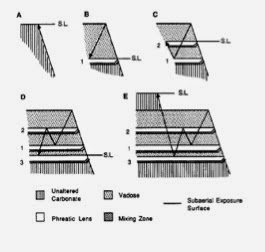
decades. In this paper, Humphrey and Quinn described the nature and
distribution of dolomite from three late Pleistocene raised reef terraces in
southeastern Barbados, West Indies. The data facilitated a conceptual model
that was then numerically tested by computer simulation. The results revealed the
how interaction of sea level fluctuations, sedimentation, rapid recurring
dolomitization, and subsidence controlled generation of dolomitic
successions.
Secular changes in ocean chemistry are
related to the mineralogy of carbonate precipitates, and had been predicted by
global ocean models. Ten years ago, Dickson described the Mg content of Cambrian
to Eocene echinoderm ossicles and compared the data to other first-order
geochemical cycles and proxies. The data revealed systematic changes coincident
with previous interpretations of ocean Mg/Ca ratios, with high mole% MgCO3
in Early Cambrian and late Carboniferous to Triassic samples, and low values in
Silurian and Jurassic to Cretaceous echinoderms. The paper suggested that the
data “add another independent line of
evidence that collectively can leave little doubt that major changes in the seawater
Mg/Ca ratio have occurred,” but noted other short-term changes.
Although the expanded Udden-Wentworth
(U-W) grain-size scale is an important tool for classifying the size of
sedimentary particles, existing terminology at the coarse end of the scale is
problematic. In this paper, Terry and Goff review how several terms
used to define size ranges on the U-W scale also have shape applications on
particle form diagrams, which can lead to confusion. To resolve this issue, the
paper proposes abandoning shape-related terms and replacing them with a new
incremental system based on meso- and macro- prefixes to classify large boulder
size ranges. The value of the modification is that both size and shape
classification of very coarse sediments can now be accomplished simultaneously
without overlap or confusion in nomenclature.