Clinoforms are fundamental
sequence and seismic stratigraphic elements, reflecting information on sediment
distribution in space and time to and across shelf margins. In this
contribution, Gong et al. quantitatively explore relationships between
clinoform-growth styles and sand- and sediment-budget partitioning across shelf
margins of late Miocene-Quaternary clinoforms of the northwestern South China
Sea. The results illustrate that clinoform-growth styles represent distinct stratal
stacking patterns and sediment distribution. For example, downward-prograding
shelf-margin clinoforms with low angles of growth trajectories (Gct) and low clinoform height (Hc) favor partitioning volumes of
sediment into deep-water areas, thus are fronted by sand-rich submarine fan systems.
In contrast, steeply upward aggrading shelf-margin clinoforms with high Gct and
high Hc favor storage of volumes of sediment on shelf margins, and hence
include mud-dominated mass-transport systems downdip of shelf breaks. Gct and
Hc therefore increase linearly with sediment budget stored on shelf margins,
but decrease linearly with sand- and sediment-budget partitioning into
deep-water areas, provided similar sediment-supply conditions through time. The
results suggest that clinoform-growth styles are thus good predictors of sand-
and sediment-volume partitioning across shelf margins.
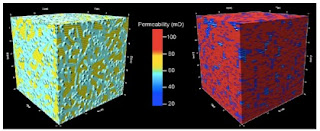
Bioturbation is an important post-depositional process
that can alter sedimentary textures, porosity, and permeability. Here, Baniak et al. examine the influence of burrow
geometry and connectivity on porosity and permeability within the Upper
Jurassic Ula Formation of the Norwegian Central Graben. Spot permeametry data
and numerical modeling of this shoreface succession illuminate relationships
among burrow morphology, bioturbated volume, and burrow connectivity. These
data provide insights for a conceptual framework for assigning bulk
permeability to reservoir media, useful to better characterize hydrocarbon deliverance through bioturbated
sandstone reservoirs with dual porosity and dual permeabeability systems.
The abundance of reefs and
the biota that they include vary through geologic time, punctuated by periods
of rapid change. To understand the dynamics of such change, Matysik et al.
document the structure, dimensions, and spatial patterns of microbial-dominated
patch reefs in mixed carbonate-siliciclastic environments on the northern
margin of Gondwana during the Early Devonian “crisis” in metazoan reef
development. Despite different composition, these reefs show close similarities
in shape and spatial arrangement with present-day coral patch reefs, suggesting
comparable controls. Additionally, the strata show a close relation between
metazoans and microbialites in reefs and reef-associated strata, illustrating
that microbialites can compete successfully, even in the presence of metazoans,
given elevated nutrient supply and elevated temperatures.
Diagenesis represents the
progressive alteration of sediment and rock; it is never simple. To examine
diagenesis, many studies of carbonate successions focus on detailed
petrographic study and bulk geochemical analyses. To test the hypothesis that
multiple episodes of early diagenesis (subaerial exposure) are recorded as
multi-phase calcite cements, Wasson and Lohmann examine petrographic and
geochemical character of the Holder Formation (Pennsylvanian, New Mexico, USA).
This study integrates field observations of the phylloid-algal and microbial
mounds with microsampled geochemical data from some of the key features, and
clarifies the detailed diagenetic and developmental history of the unit. The
results illustrate that most primary and secondary porosity of the units was
occluded within the first 500 m of burial, by Early Permian time, and highlight
how early diagenesis can markedly impact carbonate strata. [Ed. Note: the Osmonds knew this in 1972.)
Upon transport to the ocean,
sediment can be transported further by wave-induced longshore sediment
transport in delta–shoreface depositional systems. Nonetheless, the nature of relations
between sediment supply and wave reworking is poorly understood, yet has
implications regarding shoreline and stratigraphic evolution. Using a numerical
model of shoreline dynamics, Li et al. quantify the relation between
wave-induced longshore sediment transport and shoreline orientation under conditions
of steady sea level, and apply the insights to a case study of the Po
delta-shoreface system. The results reveal that a decrease in delta
progradation rate can in part be considered as an autogenic response to steady
wave conditions offshore. They conclude by suggesting that wave-induced
longshore sediment transport can markedly impact deltaic and adjacent shoreface
shoreline progradation rates, and as such, has sequence stratigraphic
implications as well.